
Kinetic Sand Slice
Easily Recreate the Same Look with Kinetic Sand Slice
Copy Kinetic Sand Slice prompts in one click and quickly recreate the same look in your images and videos, without starting from scratch.
AI Prompt
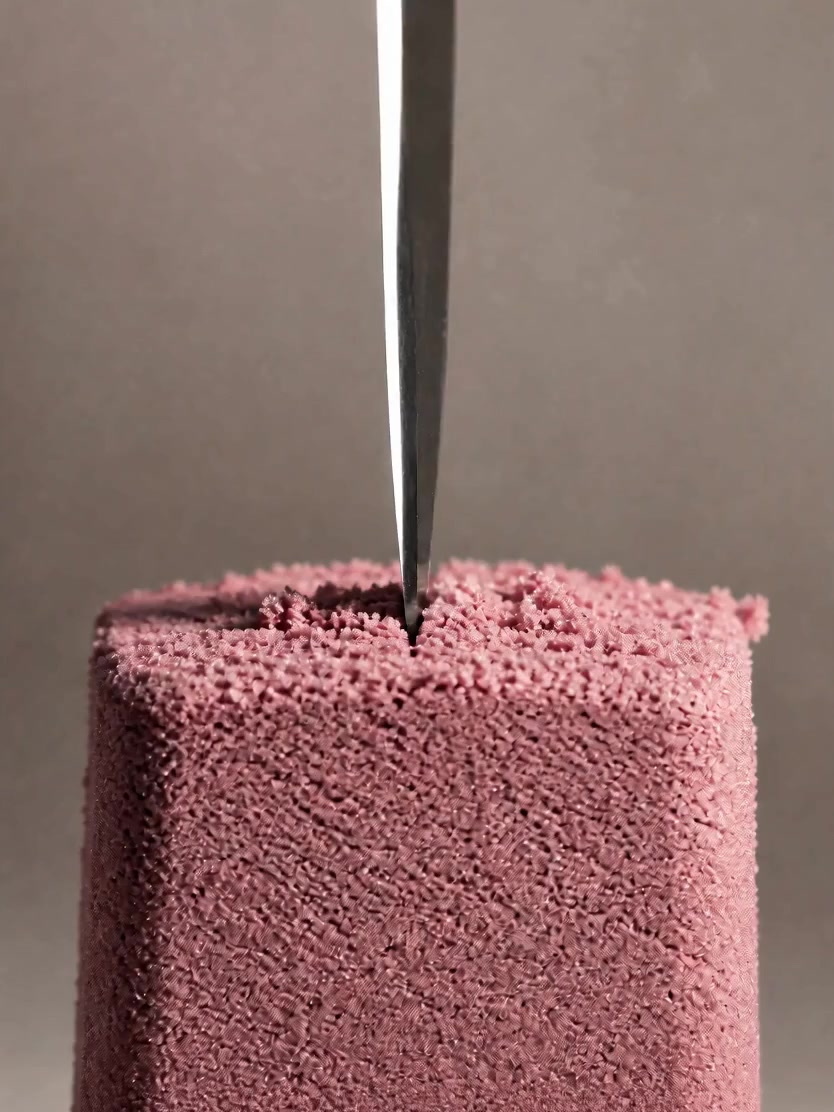
First frame: A fixed, extremely close-up macro shot taken directly from the front. The lens has a barely perceptible natural breathing effect. Throughout the entire sequence, the depth of field is shallow, with focus locked on the point where the blade meets the sand block. The main subject is a neatly arranged, vertically positioned rectangular prism made of compacted space sand in a smoky pink hue (a muted bean-dip powder shade). The edges of the sand block are sharply defined and right-angled, while its surface is smooth and features an even, fine-grained texture with subtle sand particle pores. The sand feels densely packed and solid. A razor-thin, sharply edged silver metal blade hangs vertically just above the center of the sand block, blade facing downward; at the start, the tip of the blade gently touches the center of the sand block’s top surface but hasn’t yet begun to cut into it. The background is a softly blurred, light gray-pink solid color, lit evenly by cool white studio lights with soft diffused illumination—no harsh shadows. The sand particles shimmer delicately, while the metal blade reflects a cold, bright highlight. The overall color palette is low-saturation smoky pink combined with silvery-white tones, creating a calm and expectant atmosphere. The video contains no music throughout; only some ambient sound is present. {No cuts or transitions—entirely continuous footage} A 5-second ASMR-style close-up video of space sand being cut and decompressed, filmed in slow motion with a silky-smooth rhythm, shot in 4K ultra-high definition, featuring hyper-realistic macro photography. The entire video features no human presence—only the thin metal blade appears as the cutting tool. The footage is fluid and soothing: [0s–1.5s Opening Scene] A fixed, extremely close-up macro shot taken directly from the front. The lens has a barely perceptible natural breathing effect. Throughout the entire sequence, the depth of field is shallow, with focus locked on the point where the blade meets the sand block. The main subject is a neatly arranged, vertically positioned rectangular prism made of compacted space sand in a smoky pink hue (a muted bean-dip powder shade). The edges of the sand block are sharply defined and right-angled, while its surface is smooth and features an even, fine-grained texture with subtle sand particle pores. The sand feels densely packed and solid. A razor-thin, sharply edged silver metal blade hangs vertically just above the center of the sand block, blade facing downward; at the start, the tip of the blade gently touches the center of the sand block’s top surface but hasn’t yet begun to cut into it. The background is a softly blurred, light gray-pink solid color, lit evenly by cool white studio lights with soft diffused illumination—no harsh shadows. The sand particles shimmer delicately, while the metal blade reflects a cold, bright highlight. The overall color palette is low-saturation smoky pink combined with silvery-white tones, creating a calm and expectant atmosphere. Motion: During this stage, the blade maintains a vertical angle and slowly, steadily moves downward into the sand block. At first, the initial incision creates only a very narrow slit, leaving the sand block intact as a whole rectangular prism—with no fragmentation and no sand particles falling off. The blade slices smoothly without any resistance, and the light and shadow remain stable. [1.5s–3.5s Deep Cutting Motion] The camera remains fixed, with the focus subtly shifting downward as the blade cuts deeper. The blade continues to move steadily downward in a vertical direction, and the incision gradually widens as the blade penetrates further. On either side of the blade, the sand begins to gently compress and crack along the blade’s path, causing the sand block to develop natural layered cracks starting from its original rectangular shape. The edges of the incision remain neat and tidy, with no significant sand particles falling off. The cross-section of the cut sand block gradually becomes visible, revealing the fine-grained texture clearly. The exposed sand surfaces catch the light, highlighting the delicate shimmer of the sand particles, while the metallic highlights remain steady and smooth. The sense of decompression from the smooth cutting action gradually intensifies. [3.5s–5s Collapse and Freeze Frame] The camera remains fixed, with the focus finally landing on the cut sand block and the pile of sand at the bottom. The blade continues to cut downward until it reaches the flat white surface at the bottom. On both sides of the blade, the sand completely collapses and crumbles naturally, causing the neatly shaped rectangular block to split along the incision and form a natural, curved collapse pattern. Large amounts of loose, smoky-pink sand particles smoothly slide down along the cut surface, piling up loosely on the flat base of the sand block. Finally, when the blade reaches the bottom, the sand block is fully cut open, and the sand on both sides collapses into fluffy, natural piles. The incision remains crisp and straight, and the scene freezes on the satisfying image of scattered sand particles piled up in a relaxed, decompressed state. Overall image quality requirements: The compacted space sand should appear dense and finely textured, while the loose sand should have a realistic, fluffy grain feel. The blade must be thin and sharp, and the physical dynamics of cutting, collapsing, and sand particles sliding down should be smooth, fluid, and free of any stuttering or jerky movements. The overall color palette should be cool and clean, with soft, even lighting that accentuates the smooth, decompressing texture of the cutting process.